
Thoughts on How We Talk About Falls (Part 2)
In Part 1, I wrote about why the context of a fall matters. Not every fall tells the same story, and our response should be guided by understanding what actually happened, not by fear.
This week, I want to explore three common ways we unintentionally create more fear around falls than resilience.
When Safety Comes at the Expense of Movement
Once, while working at a senior center, a woman who had recovered from a stroke attended a brain fitness class. One activity involved walking while dribbling a basketball—a dual-task exercise designed to challenge both the brain and body.
She was wearing sandals with a loose back strap. As she walked, the strap slipped off her heel, she tripped, and fell forward onto her hands and knees. She bruised her knee, was understandably shaken, but was able to get up without any serious injury.
When her daughter arrived, we explained what had happened. Her conclusion was immediate: her mom should no longer participate in standing exercises.
From my perspective, the problem wasn’t standing. The problem was the footwear. A pair of secure athletic shoes would have addressed the modifiable risk factor while allowing her to continue practicing an activity that was helping maintain her balance and mobility.
Unfortunately, that wasn’t the decision.
Even the instructor, shaken by witnessing the fall, questioned whether participants should continue doing standing activities without additional assistance.
This is something I see often. One fall leads to broad restrictions that extend far beyond the actual cause of the incident.
Instead of asking, “What contributed to this fall?” we ask, “How do we make sure this never happens again?” The easiest answer is often to remove the activity altogether.
Reducing movement doesn’t eliminate risk, it shifts it.
When people stop challenging their balance, strength, and mobility, they gradually lose the very capacities that help them recover from a loss of balance. In trying to prevent one fall, we may unintentionally increase the likelihood of future falls through deconditioning.
The goal shouldn’t be eliminating all risk. It should be reducing unnecessary risk while preserving meaningful movement.
Are We Asking the Right Questions?
A common screening questions in healthcare and senior living is:
“Have you fallen recently?”
I can’t help but wonder if they’re getting honest answers.
Imagine you’re an older adult who thinks that answering “yes” might lead to more medical appointments, increased monitoring, restrictions on activities, or even concerns about losing your independence.
How motivated would you be to report every trip or fall?
For many people, a fall represents the possibility of losing autonomy.
Rather than only counting falls, perhaps we should also be asking:
Do you have any concerns moving about your space?
What would help you feel more confident moving around?
Those questions offer deeper insight that reveal far more about a person's mobility, confidence, and support needs than simply asking whether they've fallen.
The Problem with “Fall Prevention for Seniors”
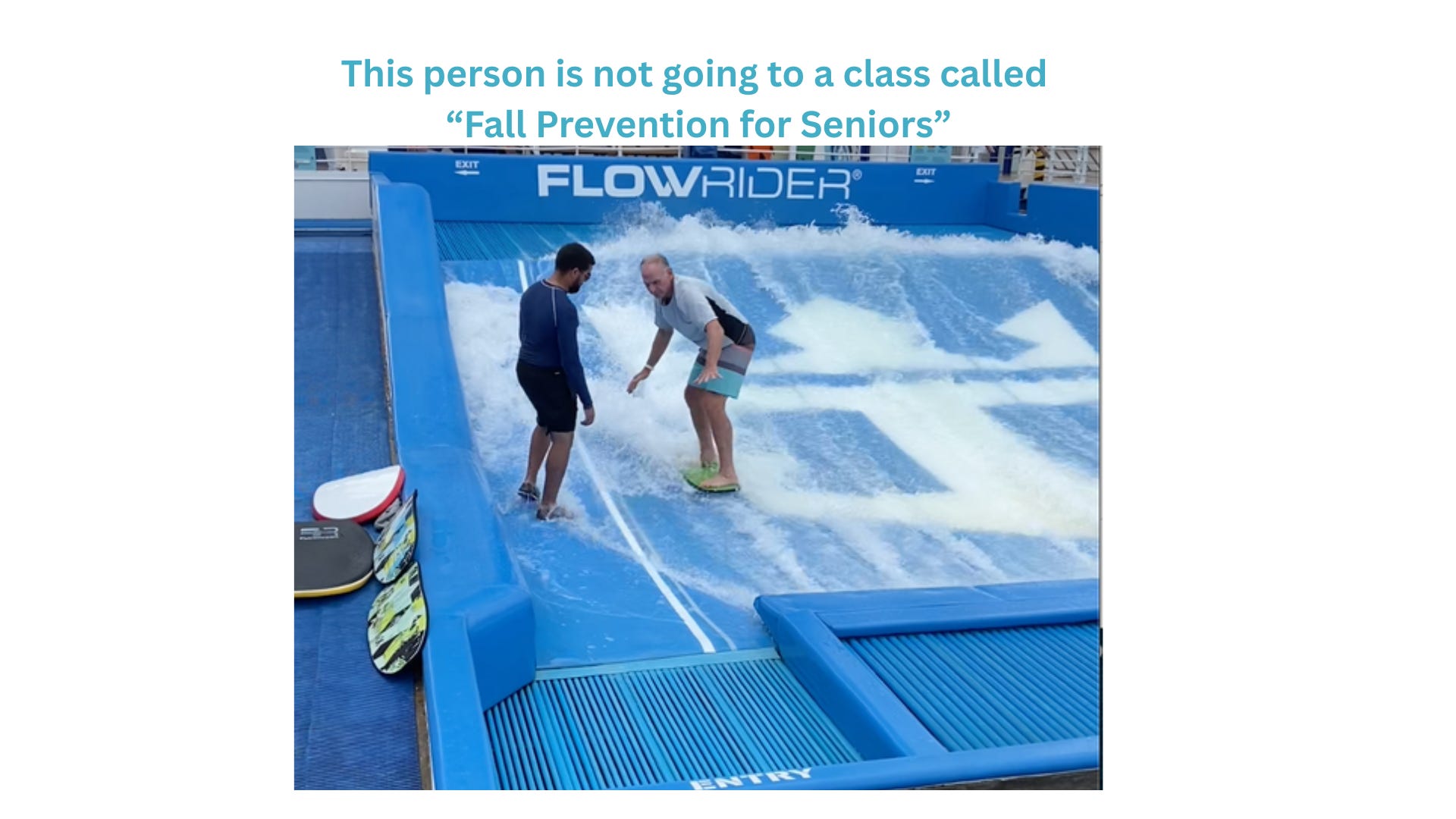
I’ve always been uncomfortable with class titles like “Fall Prevention for Seniors.” The name unintentionally suggests that falling is simply part of getting older, making it an “older person problem” instead of a human one.
Ironically, many of the people we’d most like to reach never walk through the door. Many adults in their 60s, 70s, and beyond don’t identify with the label senior, especially if they associate being old as a “bad” thing. By framing our programs around age and the fear of falling, we may actually discourage healthy, active adults from participating before they’ve experienced a fall.
The bigger question is: What are we inviting people into?
People don’t wake up thinking, I want to prevent a fall today. They want to hike with friends, play with their grandchildren, travel, and continue living life on their own terms. That’s what our class names should communicate.
Instead of focusing on what people are trying to avoid, we should focus on what they’re hoping to gain. Names like Steady and Strong to describe an aspirational outcome rather than a problem to solve. People don’t buy into “don’t fall.” They buy into feeling capable, confident, and independent.
I’ve also seen how our messaging shapes people’s beliefs. A 70-year-old woman once told me about a fall she’d had and shrugged, “I guess that’s what happens now that I’m older.”
I replied, “No, that’s what happens when you’re human.”
She hadn’t fallen because she was 70. She’d experienced a bad-luck fall, something that would have happened to anyone in the same situation.
When we automatically attribute falls to age, we make it an older person issue and fail to look at the modifiable risk factors that may have contributed to the fall (loss of vision, or hearing, medications, etc..). Falls are a human experience, not an age identity. If we want to change how people think about aging, we need to start by changing how we talk about movement and the outcomes we’re inviting people to pursue.
A Different Conversation
If we want to build true fall resilience, our language has to evolve.
Instead of responding to falls with fear, let’s respond with curiosity.
Instead of removing movement, let’s identify and address the modifiable risk factors.
The goal isn’t to create lives that are perfectly safe.
It’s to help people stay capable, confident, and engaged in the activities that give their lives meaning.
Upcoming Trainings & Events
The Movement Creative Coach Development Training
July 17th-19th in Madison, Wisconsin
A two-day immersive experience designed to deepen your skills as a movement instructor. Movement Creative is teaming up with fellow parkour senior coaches in Wisconsin to share our experience working with varied populations and situations and how to guide activities to support older adults with varying abilities.
Online Events
*All webinar registrants will receive a recording of the webinar
3 Shifts That Improve Outcomes in Adaptive Fitness
Thursday, July 23rd 3pm PT/6pm ET
In this session led by Megan Williamson, we’ll break down three common mistakes that even experienced professionals make when working with clients with disabilities — and how to shift your approach in a way that feels more clear, confident, and effective.
Building Confidence Through Movement: Helping Participants Move Beyond Fear
Tuesday, August 18th 1pm PT/4pm ET
In this interactive session led by Erin Eleu, we’ll explore the connection between fear, confidence, and movement, and how leaders can create environments that help participants feel safe, capable, and willing to try.
Elevate Your Impact with the AGEnts of Movement Webinar Library
Looking for fresh ideas and deeper insight to support the people you serve? The AGEnts of Movement Webinar Library offers practical, thought-provoking sessions designed for movement leaders working with older adults.
Explore topics like:
Coach development for Movement Leaders
Psychology of Chronic Disease
How to Coach Falling Safely
Reduce Risk of Falling Through Game Play
Balance & Your Brain
Each webinar provides practical strategies and new perspectives you can immediately bring into your classes, programs, and communities.
Learn. Grow. Lead movement experiences that matter.
AGEnts of Movement is committed to making movement education free for professionals and classes accessible for older adults
If you’d like to support this work:
Contribute to help sustain programming
Join or host a class
Share AGEnts of Movement with your community
The paradox here is correct — trying to prevent falls by reducing activity can actually increase future fall risk through deconditioning. It's the kind of counterintuitive system dynamic that looks obvious once pointed out but is easy to miss when you're in the safety-first frame.
Great discussion about the perception of falling, risk factors, and how an event can have a ripple effect to others.
It kills me to hear ‘Now that I have osteo, I have to stop since I can’t afford to fall.’ Exactly the group who needs strength and balance exercise most!